
Tackling Construction Safety: A Multifaceted Approach
Will Chung
March 14, 2024
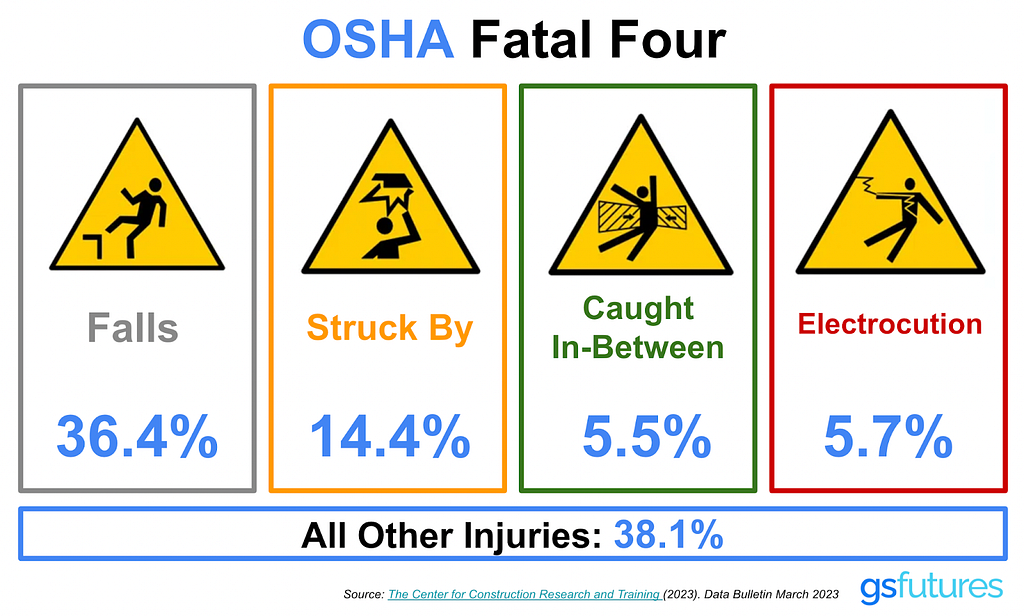
In the construction industry, safety is more than compliance — lives are genuinely at stake. But successful construction safety programs are increasingly complex and nuanced. The stark reality is illuminated by 2022's alarming statistics, which revealed an 11% increase in U.S. fatalities, amounting to 1,056 workers' lives lost, predominantly due to the "Fatal Four" hazards — falls, being struck by objects, electrocutions, and caught-in/between incidents, which together accounted for 65% of all deaths. Furthermore, the sector reported a staggering 169,900 non-fatal injuries, ranking it among the highest industries for workplace injuries and illnesses.
In 2023, OSHA's intensified inspection efforts, with 34,267 federal inspections, targeted these persistent safety challenges, focusing on mitigating the "Fatal Four" dangers in a bid to reduce the high fatality rates.
Expanding the Safety Paradigm: Beyond Technology
The construction industry's approach to safety has traditionally been reactive, focusing on compliance with regulations and mitigating risks as they occur. Yet, the evolving nature of work and the increasing complexity of construction projects demand a more proactive and integrated approach. We have structured our thoughts on construction safety in five high-level groups:
1. Cultivating a Safety-First Culture — A safety-first culture is characterized by an organizational ethos that prioritizes safety above all else. This culture is built on trust, communication, and a shared commitment to safety from both management and workers.
2. Integrative Training and Continuous Learning — Training in the construction industry must go beyond the basics of compliance and hazard recognition. It should encompass a wide range of skills, including the use of new safety-related technologies, understanding the nuances of safety in different contexts, and developing soft skills such as communication and teamwork.
3. Leadership and Accountability — Leadership plays a critical role in shaping a company's safety culture. Leaders who model safe behaviors and practices, communicate openly about safety, and hold themselves and others accountable for safety outcomes can significantly influence the safety attitudes and behaviors of their workforce.
4. Collaboration and Community Engagement — Safety in construction is not solely the responsibility of individual companies; it is a collective responsibility that spans the entire industry.
5. Safety Incentive Programs — Modern safety incentive programs pivot from traditional, purely metric-based incentives to behavior-based rewards, fundamentally encouraging proactive safety behaviors and participation.
Technology as a Catalyst for Safety Innovation
The role of technology in advancing construction safety cannot be understated. Our thorough market map and analysis underscores six primary areas: (1) Management, Training, and Compliance; (2) AI-Based Analytics & Avoidance; (3) Worksite Management and Productivity; (4) Video Monitoring; (5) IoT, Sensors, and Wearables; and (6) Risk Management and Insurance.
GS Futures aims to support safety technology beyond satisfying a compliance mandate; we aim to deeply integrate safety technology side-by-side with proactive safety culture. By harmonizing innovative tech solutions within a comprehensive safety framework, we believe there is a path towards reducing risks and setting new safety standards.
Let’s Build Together
We back ambitious founders with capital and strategic support, providing access to GS Group to accelerate scale.
Continue Reading